Blog
Is Your Technology Multiplying Your Team or Taxing It?
Most technology problems never get called technology problems. They show up as slow releases, rising spend and nervous diligence. A 35-question audit to find the drag.

Almost no CEO opens a first call with me by saying "we have a technology problem."
They say the team is slow. The agency is expensive. The roadmap keeps slipping. A big customer sent a security questionnaire and it took three weeks to answer.
Each of those sounds like its own problem. After 28 years of building and fixing software, I can tell you they usually share one cause.
The technology was built to get the company to here. Nobody has stepped back to decide what it needs to get the company to there.
Good technology makes a small team look big. Weak technology makes a big team feel small.
The quiet tax
I call it a tax because you pay it every month and never see a line item for it.
You pay it in releases that take twice as long as promised. In engineering spend that climbs while the amount that ships stays flat. In the one developer everyone is afraid to lose. In the simple question, "which customers are most profitable?", that turns into a two-week project.
The usual fix is to hire more developers. That rarely works. More people on a shaky foundation means more coordination, more rework and a bigger bill.
The real fix starts with seeing where the drag is coming from. So I wrote an audit for it.
Seven places the drag hides
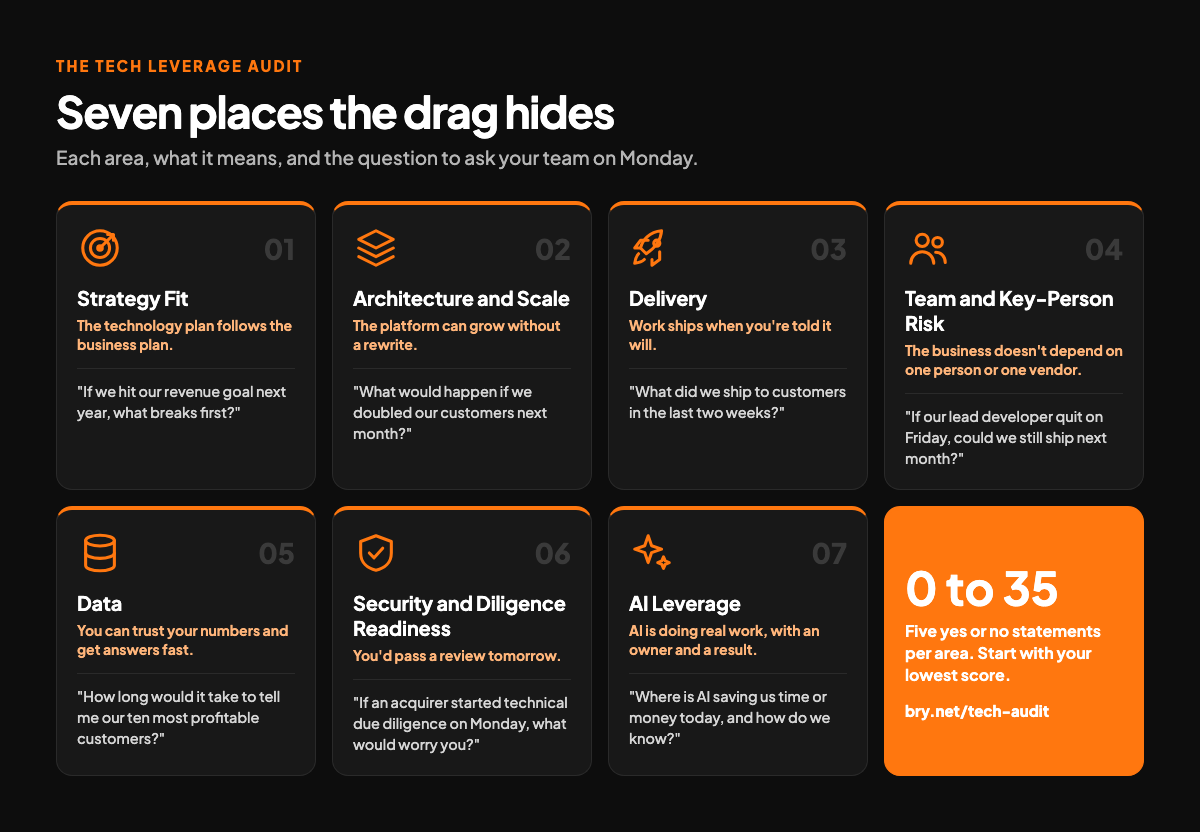
The Tech Leverage Audit looks at seven areas. You don't need to read code to score any of them. Each one comes with a question you can ask your team on Monday.
1. Strategy fit
Your tech roadmap should read like a translation of your business plan. When it doesn't, engineering stays busy on whatever is loudest.
Ask your team: "If we hit our revenue goal next year, what breaks first?"
Go deeper: Why most product roadmaps break.
2. Architecture and scale
Architecture is the shape of your system. Weak architecture shows up as fragility: small changes that break unrelated things and a "rewrite" that keeps coming up in meetings.
Ask your team: "What would happen if we doubled our customers next month?"
Go deeper: Funding falls apart because of architecture and before you rebuild, run this one query.
3. Delivery
Healthy teams ship small pieces often and tell you about trouble before the deadline. Unhealthy teams ship big batches late and explain afterward.
Ask your team: "What did we ship to customers in the last two weeks?"
Go deeper: Gherkin: stop arguing about done.
4. Team and key-person risk
Many growing companies run on a hero. A founder who codes, a long-time agency, one person with every password. Heroes are valuable. A business that can't function without one is fragile.
Ask your team: "If our lead developer quit on Friday, could we still ship next month?"
Go deeper: Why your dev agency isn't your partner.
5. Data
Your data is a record of everything customers do with you. When it is scattered across spreadsheets and tools that don't talk, every report starts an argument about whose number is right. It is also the fuel for every AI project you want to run.
Ask your team: "How long would it take to tell me our ten most profitable customers?"
Go deeper: Ingestion is the whole ballgame.
6. Security and diligence readiness
Security used to be an IT topic. Now it is a sales and valuation topic. Enterprise customers send questionnaires. Investors and acquirers run technical diligence. The basics are cheap to fix before someone else finds them.
Ask your team: "If an acquirer started technical due diligence on Monday, what would worry you?"
Go deeper: A $4M hospital deal died over one question and you don't have backups, you have hope.
7. AI leverage
Most companies are already using AI. Usually that means employees pasting company data into whatever tool they like, with no owner and no measured result. Strong AI work looks boring in the best way: a short list of specific uses, each with an owner and a number.
Ask your team: "Where is AI saving us time or money today, and how do we know?"
Go deeper: AI FOMO is how founders burn $150K and the AI strategy I give boards.
How the scoring works
Each area has five yes or no statements. Give yourself a point only for the ones that are clearly true today. If the honest answer is "sort of," it doesn't count.
That gives you a score out of 35:
- 29 to 35, a force multiplier: your technology helps a small team punch above its weight. Protect it.
- 21 to 28, working but fragile: most growing companies land here. One resignation or one diligence request can turn a weak spot into a crisis.
- 14 to 20, creating drag: your people are covering for the technology with extra hours and workarounds.
- Under 14, putting growth at risk: adding people or features right now will likely add cost faster than progress.
The total matters less than the shape. A 24 with one area at zero is a different problem than a 24 spread evenly. Start with your lowest area. That is where the drag is costing you the most right now.
What to do this week
- Take the audit yourself. It is 35 questions at bry.net/techaudit and takes about five minutes.
- Have your tech lead take it separately. Then compare. The gaps between your answers are where the real conversation starts.
- Ask one of the seven questions in your next leadership meeting. Pick the area you scored lowest and listen to how long the answer takes.
If you'd rather work on paper, the printable version has room to score each area and plot your shape.
Close
Plenty of companies run on boring tools and still score in the 30s. What they share is that they know where their technology helps the team and where it holds them back. Find that out before an investor or a lost deal tells you.
If the audit surfaces a gap, let's talk through your score. I'll tell you honestly what I'd fix first, even if the answer is that you don't need me.
What did you score, and which area surprised you?