Blog
The movie theater lesson every SaaS founder needs
At a movie theater chain we sorted every customer by how often they came. Each campaign had one job: move one group up one rung. It still works for SaaS.
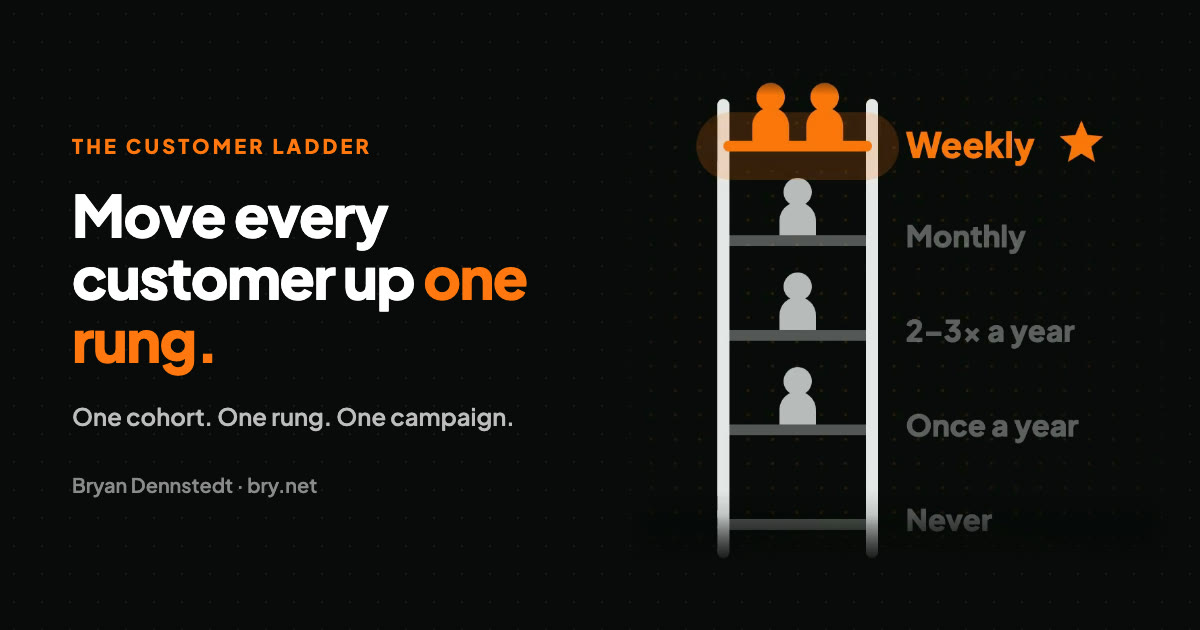
Years ago I worked at a movie theater company. We had all this data on our customers, and the smartest thing we did with it was also the simplest.
We sorted everyone by how often they came.
You go once a year to the movies, or you go two to three times a year, or once a month, or once a week.
Five buckets. That was it.
One rung at a time
Our marketing was extremely targeted toward one goal: move you up one rung on the ladder.
If you came once a year, we didn't try to make you a weekly regular. That's a fantasy. We tried to get you to come twice.
If you came a few times a year, the goal was once a month.
And if you were already coming once a week, we wanted to reward the crap out of you. You were the best customer we had. You didn't need a discount to show up. You needed to feel like the place was yours.
Every campaign had one cohort and one rung. That focus is what made it work.
Why this matters for software
I told this story last week to a founder trying to grow a subscription product. They had a big list of users and one marketing message going to all of them.
That's the mistake. A message built for your power users bores the people who log in once a quarter. A message built to win back the quiet ones annoys the people who are there every day.
The ladder fixes that. Your product has the same five buckets. You just haven't drawn them yet.
How to build your ladder
Here's how I'd do it for a SaaS or marketplace business:
- Pick one behavior that means value. A login, an order, a booking, a report run. One thing.
- Count it per customer over a fixed window. Ninety days is a good start.
- Cut the counts into four or five rungs. Never, rarely, sometimes, often, always.
- Write one campaign per rung. Each one has a single job: get this group to the next rung.
- Reward the top rung with early access, a thank-you, or a direct line to you. Not a coupon.
You can pull this out of most databases in an afternoon. With AI writing the query, maybe an hour.
What changes when you do this
The numbers get honest. Instead of "engagement is up," you can say "we moved 140 people from rarely to sometimes this month."
The campaigns get cheaper, because each one is small and targeted.
And your team stops arguing about the one perfect message. There isn't one. There are five, and each has a clear job.
The trap to avoid
Don't try to jump people two rungs. The once-a-year customer who gets a "come every week" pitch tunes out. One rung is believable. Two is a stretch. Five is spam.
This came out of a theater lobby. It works because it respects where the customer is today.
One cohort. One rung. One campaign.
If you want help drawing the ladder for your product, that's a good first conversation. Book a call at bry.net.
How many rungs does your customer ladder have right now?