Blog
Serialize, don't parallelize: the one rule I give every CEO using AI
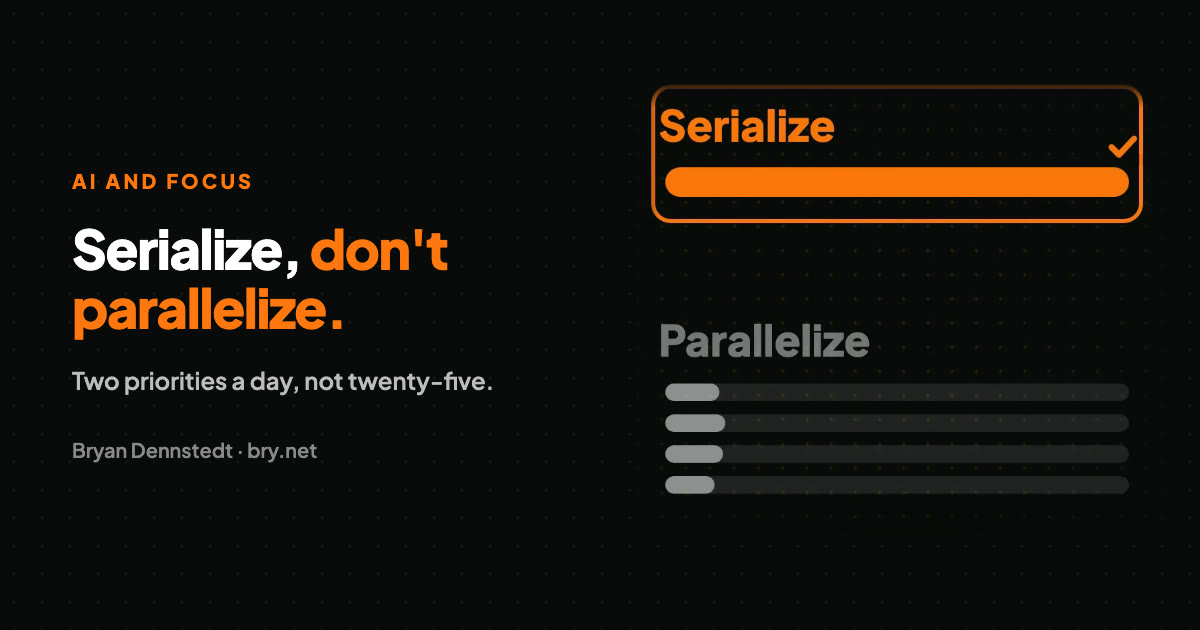
AI lets one developer juggle a dozen projects at once. The cost moved to the human switching between them. Hand out two priorities a day, not twenty-five.
I was on a call with a startup CEO recently, talking about his lead developer.
The developer was busy. Lots of AI-assisted work going in. But it was spread across so many projects that nothing was landing.
So I said what I say to every CEO who has handed a developer an AI coding tool:
I'd rather see you serialize instead of parallelize the projects.
The cost didn't go away. It moved.
I run a lot of AI projects side by side myself. The AI does the typing. That part really is cheap now.
What it doesn't do is carry the context for me.
Every time I come back to a project, I have to read through the past three or four pages of what happened. Get my head into it. Nudge it. Then it goes off and does the next hour's worth of work, and I move to the next one and do the whole thing again.
That reload is the tax. AI didn't remove the cost of context switching. It moved it onto the human, and it made it easy to pile up more switches than any person can carry.
A developer with 25 open projects isn't 25 times as productive. He's spending his day re-reading.
What the CEO controls
This is where the CEO comes in.
The developer can't fix this alone, because the developer doesn't own the priority list. The CEO does. Every new idea dropped into a chat thread is one more context the developer has to keep warm.
So the feedback I gave was simple. In standup tomorrow, say this:
These are the only two things I want to move forward today.
Chase those. If you get to anything else, great. But these two are the ones that count.
The more you give him the priority, the less he has to context shift, and the more he can chase that one thing to done.
Why two, and not one
One is ideal on paper. In practice, AI work has waiting built into it. You kick off a long task, the agent grinds, and you have a few minutes.
A second priority fills that gap without blowing up your head. A third starts to cost you. By the fifth, you're back to re-reading all day.
Two is the number I give CEOs because they'll actually hold to it.
How to tell if your team has this problem
You don't need a dashboard. Look for these:
- Lots of commits, few releases. Code is moving, nothing is shipping.
- Every status update says "in progress." Nothing closes.
- The developer can't answer "what got done this week" in one breath.
- You, the CEO, have added more than two new asks since Monday.
That last one is usually where it starts.
What to do this week
- Write down every open project your developer is touching. All of them.
- Pick two. Out loud, in standup.
- Park the rest on a visible list so nobody feels their idea died.
- Next week, check what shipped. Then pick the next two.
AI made the building cheap. It made focus the scarce thing. Your job as CEO is to protect it.
Two priorities. Not twenty-five.
If your team is busy but nothing is landing, that's the kind of thing I sort out in a first call. Book a call at bry.net.
How many projects is your best developer juggling right now?