Blog
You can't build the assembly line while running it full speed
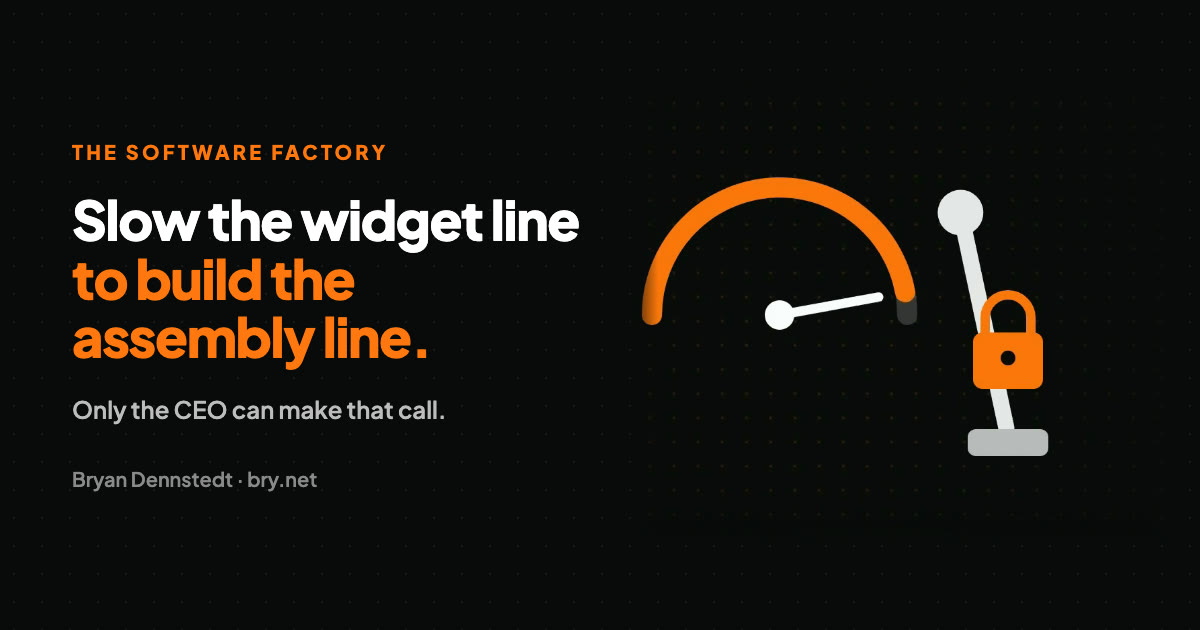
The companies that got the most out of AI engineering had a CEO who agreed to slow down the widget line to build the factory. Without that, you get vibe coding.
Before I touch a single tool on an AI engineering rollout, I ask the CEO one question.
Do you know where you want to go?
Is the goal to get 30 people vibe coding, or to build a software factory? Those are completely different projects. They have different costs, different timelines, and different people who have to say yes.
What the early winners had in common
Some of the earliest companies I worked with that adopted the AI software factory concept all had one thing. The CEO bought in, and the CEO was the one demanding that we slow down the building of the widgets and focus on the assembly line.
Without management's buy-in, we can't slow down the widget assembly line.
That's the whole game.
Two ways to build a factory
You have exactly two options.
You either add people to build the new assembly line in parallel while the current line keeps running. Or you slow the current line down.
Most startups can't afford the first one. So it's the second, and that's where the CEO comes in.
Why the CEO has to own it
Every engineering team has a widget line. Features go in the top, releases come out the bottom, and somebody upstairs is counting.
Building a factory means pulling your best engineers off that line for a while. They're writing the specs, the test harnesses, the agent workflows and the deploy pipeline that make the next hundred features cheap.
For a while, output drops.
A head of engineering can't make that call alone. The minute the sales team asks where the feature went, the factory work gets cut. Only the CEO can look at the board and say, "We're slowing down on purpose, and here's why."
Vibe coding is fine. Just call it what it is.
If the goal is to get everyone using AI tools to write code faster, great. Buy the licenses. Run a workshop. You'll get a bump.
That's a productivity rollout. Each developer gets a little faster, and your process stays exactly the same.
A software factory changes the process. Requirements go in, tested and deployed code comes out, and the humans spend their time on the parts the machine can't do yet.
You don't drift from one into the other. Somebody has to decide.
The teams I see stuck in the middle bought the tools, waited for a factory to appear, and got frustrated when it didn't. Nobody told them the factory was a project with its own budget and its own deadline.
The conversation to have first
If you're a CEO about to fund an AI engineering push, settle these before you spend anything:
- What's the objective? Faster individuals, or a new way of building?
- What are you willing to slow down? Name the features that will wait.
- For how long? Put a date on it so the team isn't guessing.
- Who defends the decision when a customer or an investor asks where the roadmap went? (Hint: you.)
If you can't answer the second question, you're doing a vibe coding rollout. That's fine. Just don't expect factory results from it.
Decide first. Then build.
I walk CEOs through this decision before any build starts. If you're there, book a call at bry.net.
Has your team been asked to build the assembly line while still hitting every widget deadline?