Blog
Steak vs. AI Image: The Real Water Story
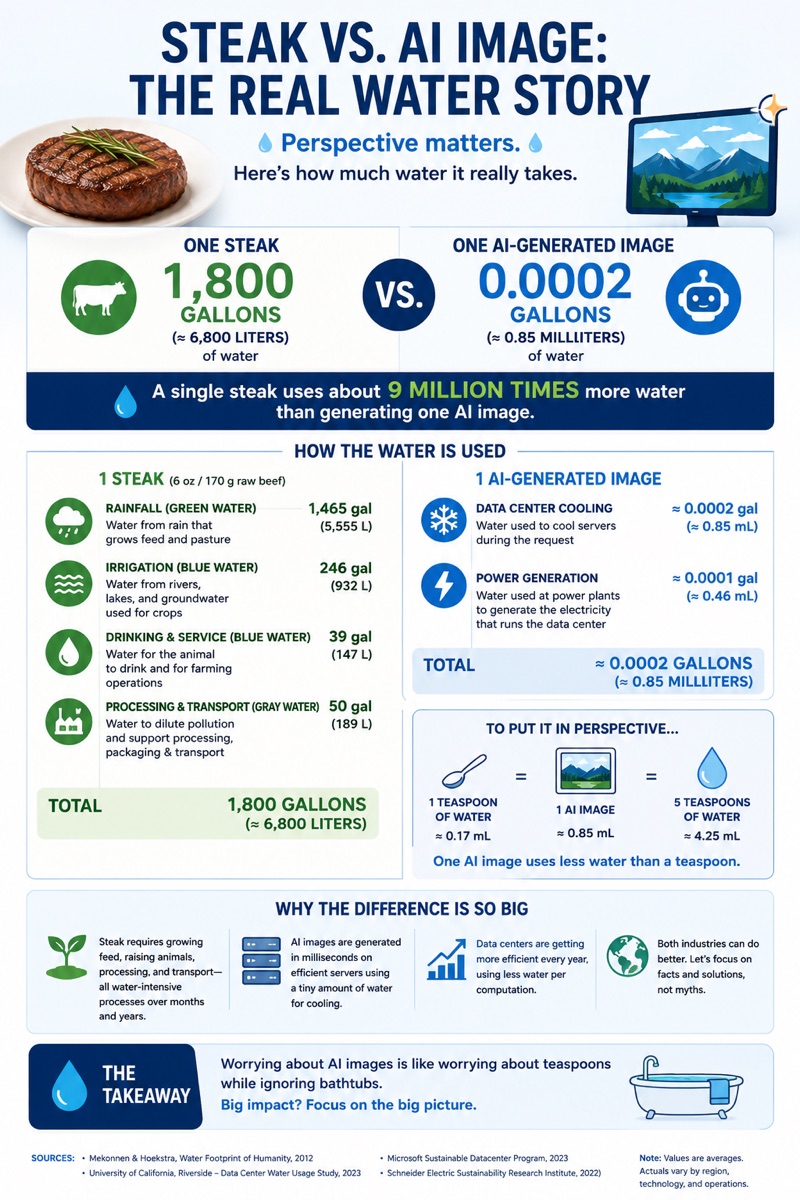
One steak takes about 1,800 gallons of water. One AI image takes about 0.85 milliliters. That is roughly nine million to one. I gave up steak partly over numbers like this, so when the internet rages about AI water while the burger sits right there, I have to say something.
Last post I made the case that a single AI image uses less water than a drop off your finger. Some people did not love that. Fair. So let me put it next to something we do not usually flinch at.
A steak.
The two numbers, side by side
One six-ounce steak carries a water footprint of about 1,800 gallons. That is roughly 6,800 liters, for one piece of beef.
One AI-generated image uses about 0.0002 gallons. That is around 0.85 milliliters. Less than a teaspoon.
Do the division and a single steak uses on the order of nine million times more water than generating one AI image. Not double. Not a hundred times. Nine million.
Where 1,800 gallons goes
The steak number is not a trick. It is a lifecycle footprint, and here is what it is made of:
- Rainfall to grow feed and pasture: about 1,465 gallons. This is the water that falls on the fields that grow what the animal eats over its whole life.
- Irrigation from rivers and groundwater: about 246 gallons. Water pulled from the actual freshwater supply to grow crops.
- Drinking and farm operations: about 39 gallons. What the animal drinks and what the farm uses around it.
- Processing and transport: about 50 gallons. Slaughter, packaging, moving it to your plate, and diluting the pollution that comes with all of that.
Add it up and you get 1,800 gallons before it hits the grill.
The honest caveat, because I will not cheat the comparison
I care about being right more than I care about winning the argument, so here is the fine print.
Most of that steak number is green water, meaning rainfall that fell on grazing land anyway. That is not the same category as the treated blue water a data center pulls from a municipal supply to cool servers. A hydrologist will tell you that comparing green rainwater to blue cooling water is not perfectly apples to apples, and the hydrologist is right.
So account for it. Throw out the rainfall entirely. Count only the irrigation, drinking, and processing water for the steak, the parts that hit the real freshwater supply. That is still about 335 gallons of blue and gray water per steak, against 0.85 milliliters for the image.
That is still well over a million to one. The caveat shrinks the gap. It does not close it. It does not come close to closing it.
Why I am the one saying this
I do not eat steak. I read these exact water and land numbers years ago and they were part of why I changed how I eat. So I am not here defending beef. If anything I am the last person who would.
That is the point. A vegan is telling you that the water panic aimed at AI images is pointed at the wrong plate. If water is the thing that moves you, and it moves me, then the single highest-leverage water decision most people make in a day is the one with a fork, not the one with a keyboard.
You can generate an AI image every ten seconds for a year and not touch the water footprint of one steak dinner.
What to actually do about it
If you want to spend your water conscience well this week, here is the ranked list, biggest lever first.
- Look at your plate before your prompt window. One or two plant-based meals a week moves more water than never touching an AI tool again.
- Fix the leaks you can see. A running toilet or a dripping line at home outruns your entire year of AI usage in a couple of days.
- Push the aggregate where it belongs. Data center water is a real engineering problem, and it is on the companies and the grid to keep improving cooling and energy mix. That pressure is worth applying. Per-image guilt is not.
The takeaway
Worrying about the water in an AI image while a steak sits on the plate is like worrying about a teaspoon while the bathtub overflows behind you.
I am not asking you to feel bad about dinner. I am asking you to keep the scale straight. When the concern is real, and water is real, put it where the water actually goes.