Blog
The Camera Used to Be Evidence. Now It Is a Suggestion.
You are somewhere beautiful, you smile, you take the picture, and your phone fixes the sunset before you ever see it. Then you warm your tan and erase the tourist behind you. When did it stop being a real photo? The uncomfortable answer, and a rule for how far is too far.
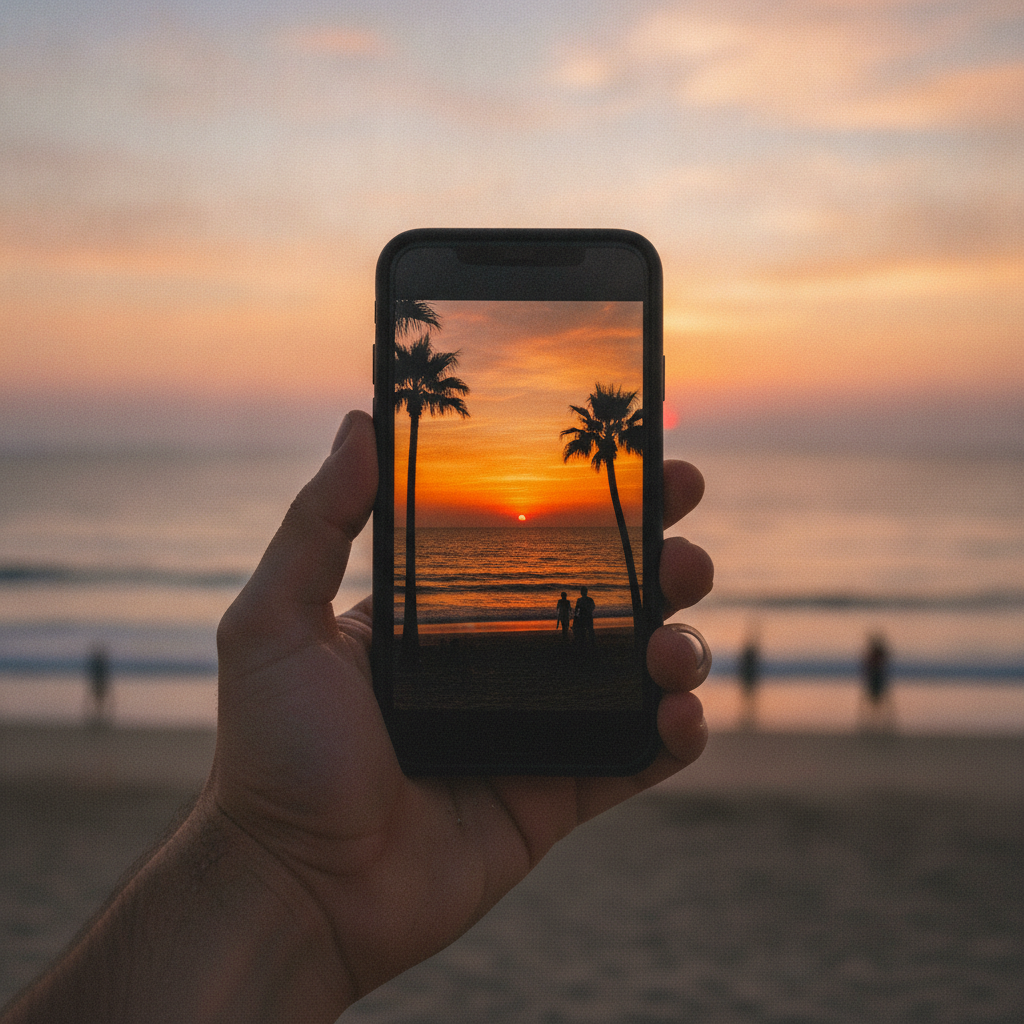
You are standing somewhere beautiful. The light is good, you smile, you take the picture. By the time it lands in your camera roll a second later, your phone has already fixed the sunset, calmed the shadows, and smoothed your skin a little. You did not ask it to. It just did.
Now you keep going. You warm up your tan with a slider. You nudge your smile a hair wider. You tap the tourist standing behind you and he vanishes, replaced by a stretch of beach that was never actually empty. You send it to your family. This is my trip.
Somewhere in that sequence, was there a moment it stopped being a real photo? I have been chewing on this, and the honest answer bothered me. There was no such moment, because it was never a real photo to start with.
Your phone never took one picture
Here is the part almost nobody realizes. When you press the shutter, your phone does not capture a single frame. It captures a burst of them, at different exposures, and merges them into one computed image before you ever see it. That is what HDR is. Apple, Google, and Samsung all do it, by default, on every shot.
So the picture you think of as the raw, untouched original is already a composite that no single instant of reality ever looked like. "Straight out of camera" stopped meaning anything years ago. The sunset was fixed before you got a vote.
That is the floor. Everything else is a question of degree.
From fixing to fabricating
There is a real line in here, and it is worth naming precisely. Some processing reconstructs what was actually in front of you: pulling detail out of shadow, steadying your shaky hands, balancing a sky your eyes also adjusted to in the moment. Fair enough. Your own vision does versions of that.
Then there are features that invent things that never happened, and they are already in your pocket.
Google's Best Take will take a group photo and swap in each person's face from a different second, so everyone is smiling in a frame that never existed. Magic Eraser and Apple's Clean Up will delete the tourist and generate fresh sand where he stood, painting in pixels no lens ever saw. In 2023 someone pointed a Samsung phone at a deliberately blurred photo of the moon on a monitor, and the phone handed back crisp craters that simply were not in the source. Samsung's explanation was that its software recognizes the moon and enhances the detail. Which is a careful way of admitting the detail was added.
None of that is editing a photograph. It is manufacturing one and calling it a photograph.
Two camps, and they are moving apart
Ask who gets to decide where the line sits and you find two worldviews heading in opposite directions.
Google's Pixel camera lead, Isaac Reynolds, has said the quiet part out loud. His framing is memory, not record:
Your memories are your reality. What's more real than your memory of it?
The goal, in his words, is to produce the moment you wanted and remembered, not the one the sensor happened to catch. Under that view, erasing the tourist is not a lie. It is restoring the picture to what the day felt like.
Now the other camp. World Press Photo, which governs the most serious photojournalism on earth, spent 2026 tightening its rules in the exact opposite direction. To them a photograph is light recorded on a sensor, full stop. No generative fill. No adding, moving, or removing people or objects. They will let you crop and clean a dust speck, and that is nearly the whole list.
Same technology, two irreconcilable answers. One says a photo is a feeling you are allowed to perfect. The other says a photo is a fact you are not allowed to touch.
So how do you even know?
This is the part that should worry you more than the sliders. When someone hands you a photo now, you usually cannot tell from the image itself what was done to it. The pixels look clean either way.
The industry's answer is provenance: proving where a picture came from instead of judging the pixels. C2PA Content Credentials attach a signed, tamper-evident history to a file, a kind of nutrition label showing what device shot it and what edits touched it. Google is starting to stamp video from recent Pixels this way. Its SynthID system hides an invisible watermark inside AI-generated images and has tagged a hundred billion of them, and it is starting to show up in Search and Chrome as an "is this AI?" signal.
That is real progress, and it is worth supporting. But do not mistake it for a lie detector. Content Credentials record history, they do not rule on truth, and the label can be stripped off a file entirely, so its absence tells you nothing. And researchers have already shown you can forge one of these invisible watermarks onto a picture that was never watermarked, so its presence does not prove much either. For now, the honest position is that you often cannot know, and anyone who tells you a photo is provably real is overselling.
Where I land on "too far"
The line was never really about the pixels. It is about the promise.
Every photo comes with an implied claim. A shot you send your family that says this is roughly how the trip felt is a memory, and warming the light or smoothing your tan is inside that promise. A shot that says this is what happened, believe it, is a record, and the moment you invent a smile, delete a person, or add craters that were not there, you have broken the deal, whether a court, a customer, or your kids are the audience.
So my rule is short. Decide what the picture is for before you edit it, and be honest with whoever sees it about which one it is. Fixing how it felt is fine. Fabricating what happened and passing it off as evidence is the line.
What to do this week
- Learn your phone's defaults. Open your camera settings and see what is on. You are already shipping edited photos and calling them originals.
- When it has to be real, keep the original. For anything that might matter later, a receipt, a claim, a record, save an unedited copy and note that it is untouched.
- Stop trusting the pixels. Assume any photo you are shown could be fabricated, especially the emotionally convenient ones. Look for content credentials, but treat them as a clue, not a verdict.
- Say what you did. If you erased the tourist, it costs you nothing to mention it. Honesty about the edit is the whole ballgame.
The camera used to be the thing we reached for when we needed proof. Point it, click, done, argument over. That era is ending. The camera is becoming a suggestion, a draft of reality that each of us finishes to taste.
The useful question is no longer whether a photo is real. It is what the photo is for, and whether the person showing it to you is being honest about that. Everything now runs on that honesty. Guard it.