Blog
The three jobs left for developers in an AI software factory
When an AI software factory writes the code, the developer role splits three ways: requirements, building the factory, and the last mile of QA and deployment.
I had an intro call recently with the owner of a development firm. Good operator. Big team. And a question sitting under the whole conversation: what happens to all these developers?
I told him what I've been telling every founder who asks.
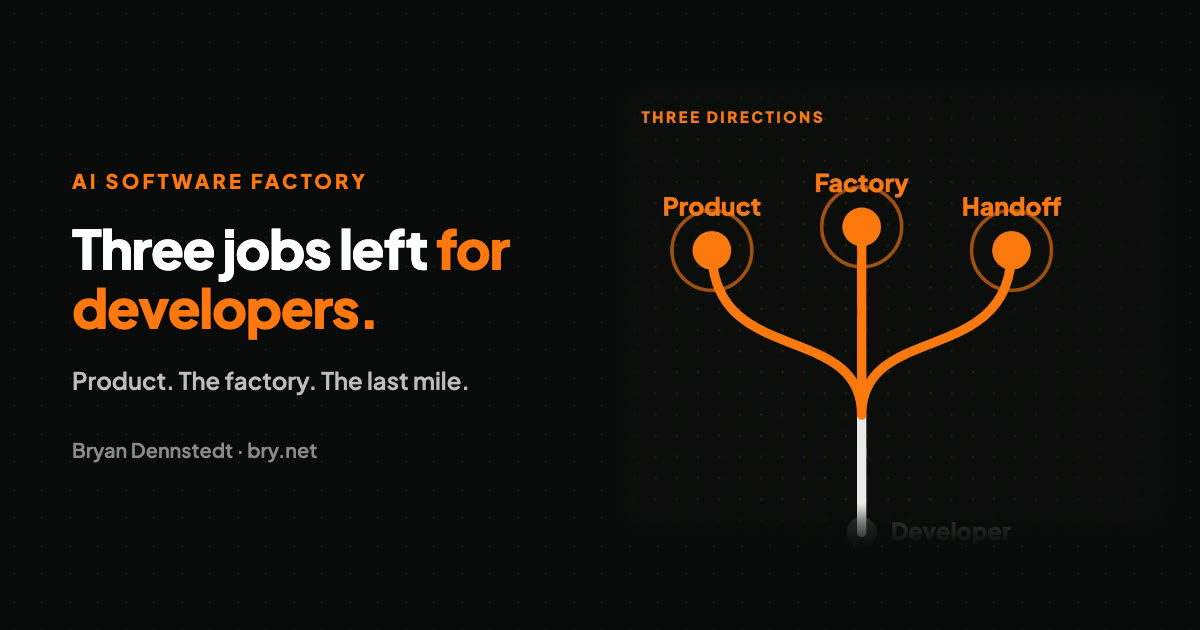
I personally see developers going in three directions.
There's going to be a lot less "write this function" work. That doesn't mean the people go away. It means the job splits.
Direction one: product management
Some developers have a knack for pulling the requirements out of people. They sit with a customer or a CEO, ask the annoying follow-up question, and come back with what the business actually needs.
That skill just became the most valuable thing on the team.
When an AI factory can build a feature overnight, the constraint is knowing what to build. Developers who are good at that are going to slide into product roles, whether their title changes or not.
Direction two: babysitting the factory
The second group wants to make the factory better.
These are the people who look at the pipeline of agents, prompts, tests and deploy scripts and say, "this step keeps failing, let me fix the machine." They tune the prompts. They add the guardrails. They build the internal tools that make the next hundred features cheaper.
This is platform engineering with a new name. It's real engineering, and it's where a lot of senior developers will be happiest.
Direction three: the last mile
The third direction is the work the factory still struggles with: QA and deployment.
Getting code written is the easy half. Every customer has a unique situation and a unique deployment. Getting the code tested against real data, deployed into that environment, and handed off cleanly is where factories still trip.
And the handoff has a human side. Somebody has to write the training, record the videos, and walk the customer through what just came out of the factory.
Somebody has to own that last mile. That's a job.
What's left out
What's not on the list is a developer whose whole day is typing code from a ticket. I don't think there are going to be a lot of developer jobs, per se, that look like that in a couple of years.
There's going to be a lot more product management, a lot more infrastructure, and a lot more people building the factory.
One warning for anyone building a factory. The bad ones put the humans on QA and code review for everything the AI writes. You'll get bored of that really fast, and so will your best people. If the factory needs a human to check every line, you haven't built a factory. You've built a typing pool with extra steps.
What to do this week
If you run a dev team, or you buy from one:
- Sort your people. For each developer, which of the three directions fits? Ask them. Most already know.
- Find the requirements person. Every team has one. Give them more time with customers.
- Name a factory owner. One person responsible for making the pipeline better each week.
- Look at your last mile. Where do releases stall? That's where your third group goes.
If you're a dev shop owner, the same sort applies to your bench. The firms that retrain toward these three jobs will be fine. The ones still selling hours of typing are going to have a hard year.
I help companies stand up AI software factories and reshape their teams around them. If that's on your list, book a call at bry.net.
Which of the three directions are you seeing on your team?