Blog
Why Is Anyone Still Sweeping the Sidewalk?
I passed a fancy hotel downtown and watched a man sweep the sidewalk, and could not stop thinking: why is a person still doing this in 2026? The self-cleaning lobby is a camera and a Roomba, every piece already ships, and once you see the pattern you find it on every block.
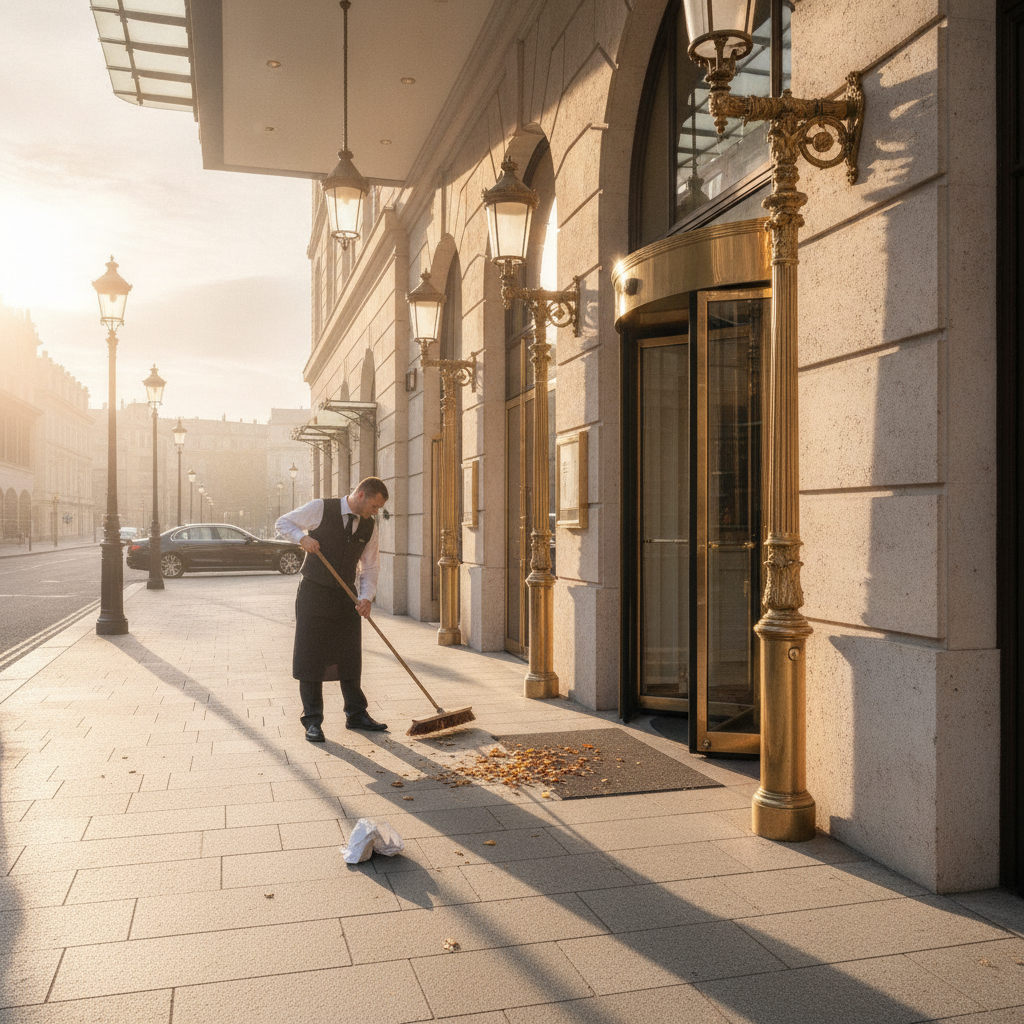
I was walking downtown last week and passed a very nice hotel. Out front, a man was sweeping the sidewalk. Not a mess, just the usual scatter of a busy entrance, a few leaves and a scrap of paper. He was doing a careful job. And I stood there for a second thinking, why is a person still doing this in 2026?
That is not a knock on him. It is a knock on the fact that the job exists at all. A hotel that nice pays someone to walk that same twenty feet of concrete, over and over, all day, looking for small pieces of trash and removing them. It is honest work and it is completely solvable, and once I saw it I could not stop seeing versions of it everywhere I looked.
The actual machine, spelled out
Here is the whole system, and there is nothing science fiction about any piece of it.
Mount a camera high on the building, out of the way, where no guest ever notices it. Point it at the entrance. It watches that stretch of ground all day and knows what clean looks like. The moment a wrapper blows in or someone drops a receipt, it sees the difference, marks the exact spot, and sends a small floor robot straight to it. The robot rolls over, picks it up, and goes back to its dock. Then in the quiet hours after midnight, the same fleet comes out and sweeps and polishes the whole entrance while the city sleeps.
Nobody sweeps the front of that hotel again. The lobby cleans itself.
That is one building, one small idea. The reason it matters is that the same shape is hiding under a thousand other jobs, and once you learn to see the shape you find it on every block.
None of this is waiting on invention
The reason we file this under someday is that we have watched self-cleaning everything in movies for forty years, so the whole idea feels like set dressing for the future. It is not. Every part of it already ships.
Computer vision that can pick a bottle cap out of a photo is a solved problem you can rent by the hour. Robots that navigate a space on their own and scrub floors overnight are already humming through big-box stores and airport terminals after closing. Cheap compute to run the whole loop is sitting in a box the size of a paperback. We are not waiting on a breakthrough. We are waiting on someone to bolt the existing pieces together and for the price to drop below what that sidewalk currently costs in wages.
Both of those are happening right now. That is why I think the self-cleaning entrance is a five-to-ten-year thing, not a someday thing. The hard part was never the science. It was the integration and the math, and the math gets better every quarter.
Learn to see the shape
The sweeping man is a stand-in for an entire category of work. Strip his job down and it is this: watch a defined space, notice a small problem, go handle it, repeat. That exact pattern is everywhere.
The parking lot that gets walked for stray carts. The grocery aisle checked for a spill. The pool deck cleared of towels. The warehouse row scanned for a box in the walkway. The office that gets tidied every night by someone going surface to surface. Every one of those is the same loop, and every one of them is the kind of narrow, physical, repeatable task that cheap cameras and cheap robots are about to be very good at.
The mistake leaders make is looking for the giant, glamorous AI project. The real opportunities look like a broom. They are small, boring, and repeated a hundred times a day, and that repetition is exactly what makes them worth automating.
The part I will not skip over
That sidewalk is somebody's paycheck. I am not going to wave that away with a line about everyone moving on to better things, because that is not always how it goes, and pretending otherwise is how technologists lose the room.
Here is what I will say. The work that is easiest to hand to a machine is the work we most wish we did not have to pay a person to stand and do all day. The honest move is to see it coming, say so plainly, and put real thought into where those people go next, instead of acting surprised when the robot shows up. The change is coming either way. The only choice is whether you meet it with a plan or with a shrug.
What to do this week
- Walk your own operation and count the brooms. Every task that is watch-a-space, notice-a-thing, go-fix-it. Write them down. That list is your automation roadmap, in priority order.
- Start with the most repeated one, not the most impressive one. The task someone does forty times a day beats the flashy moonshot every time.
- Price the status quo honestly. What does that repeated task cost you a year in wages, turnover, and attention? That number is the budget you have to work with, and it is usually bigger than you think.
- Assume the pieces already exist. Before you decide something is too futuristic, go check. Most of the time the camera, the robot, and the model are all sitting on a shelf waiting to be wired together.
The future of AI is not going to arrive as one humanoid butler walking through the lobby. It is going to arrive as a camera you never notice and a Roomba you never think about, and one morning you will realize nobody has swept that sidewalk in months.
Once you see the shape, you cannot unsee it. Look around on your next walk. They are everywhere.