Blog
Ikigai: The Four Circles I Draw Before I Say Yes
A founder asked why I went fractional. I drew four circles on a napkin. The Japanese call the center ikigai, a reason to get up. Here is how I use it.
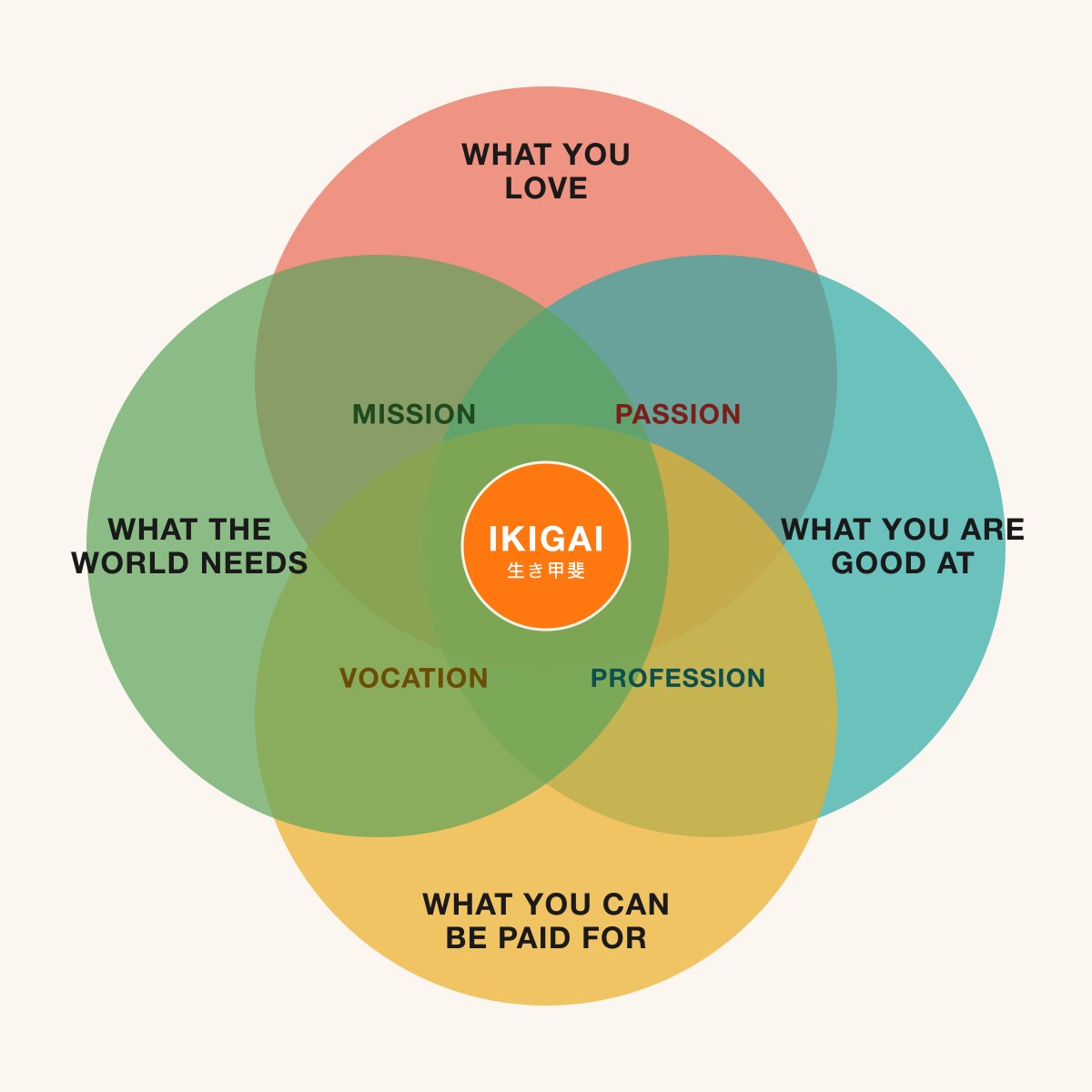
A founder asked me over coffee last month why I went fractional instead of taking another full-time CTO seat. Good money, real title, his words.
I grabbed a napkin and drew four circles.
He thought I was stalling. I was answering the question.
The four circles are a tool I have used on myself for years, and lately on the leaders I work with. The center of them has a Japanese name, ikigai. It roughly means a reason to get up in the morning. Not your job. Your reason.
Here is the version most people have seen.
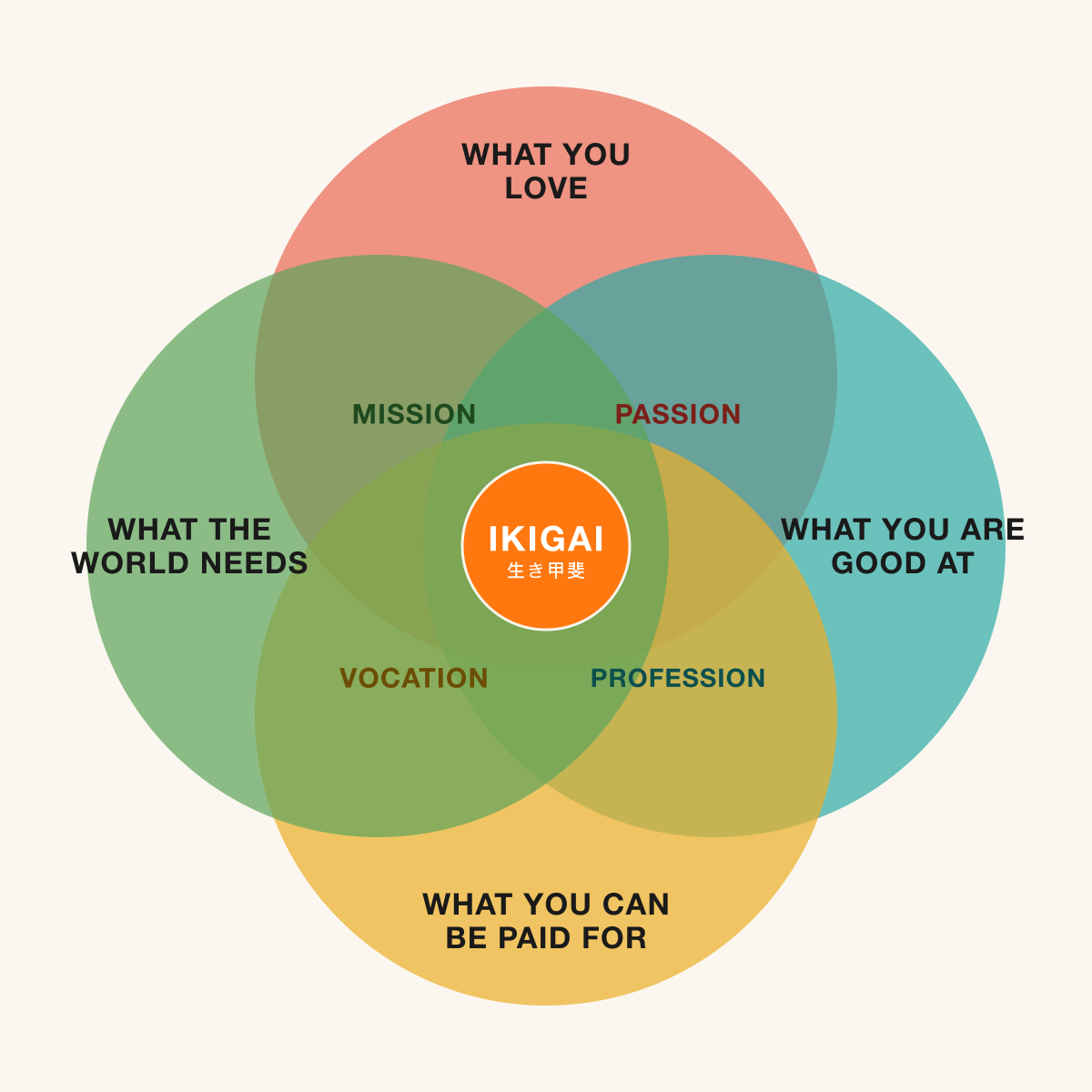
The four circles, plain
Four questions, one per circle.
What do you love. What are you good at. What does the world need. What can you be paid for.
Where two of them overlap, you get something with a name.
Love plus good at is passion. You are great at it and you would do it for free. It also might not pay, and the world might not care.
Good at plus paid is profession. This is most careers. Solid, fundable, and quietly hollow if you stop there.
Paid plus needed is vocation. Useful and lucrative work you have no real feel for. You can do this for a decade and feel like a stranger in your own calendar.
Needed plus love is mission. The work that pulls you out of bed and pays you in meaning and nothing else.
The center, where all four meet, is ikigai. That is the claim, anyway. I want to come back to that claim, because it is half wrong and the half that is wrong matters.
Why the picture is useful
I have sat with a lot of smart, miserable people. Founders at year three. Engineers who hit staff level and went flat. A CEO who told me his company was doing great and said it like a man reading a hostage note.
Almost every one of them was living inside one circle and calling it a life.
The profession people are the most common. Good at it, paid well for it, and slowly going numb. The circle is real, the paycheck is real, and two of the four questions never get asked.
The mission people are the other failure mode. All heart, no runway. They love the work, the world needs it, and they are three months from broke because nobody drew the paid circle.
The picture is useful because it makes the missing circle obvious. You stop asking "am I happy," which has no answer, and start asking "which of these four am I actually skipping," which does.
That is the whole trick. Four small questions beat one giant one.
Where the picture lies to you
Now the honest part, because I respect this idea too much to hand it to you clean.
That four-circle diagram is not Japanese. It is a mashup. The Venn comes from a 2014 blog post by a man named Marc Winn, who took a purpose diagram drawn by Andres Zuzunaga and stamped the word ikigai in the middle. It went around the world on slide decks. Mine included.
The actual Japanese idea is smaller and better. Ken Mogi, a neuroscientist who wrote a whole book on it, describes ikigai through ordinary things. The first sip of coffee. Tending a garden. The craftsman who has made the same knife for forty years. Akihiro Hasegawa, a psychologist who studied the word, found most people in Japan tie it to small daily life, not to a grand career sweet spot.
Read that again. The original ikigai does not require you to get paid. It does not require the world to need it. A grandmother who lives for her morning walk and her grandkids has ikigai. The Venn would tell her she is missing two circles. The Venn is wrong, and she is fine.
So I hold both. The four circles are a fantastic diagnostic for work. They are a terrible definition of a life. Use the diagram to fix your career. Do not let it audit your soul.
How I used it on myself
Back to the napkin.
For most of 28 years I lived in the profession circle. Good at building and leading engineering, paid well to do it, and I had quietly stopped asking the other two questions. The full-time CTO chair the founder was waving at me was a bigger, warmer version of the exact circle I already knew was too small.
What I love is the first ninety days of a hard problem. Diagnosis, architecture, getting a team unstuck. What I am good at is walking into a mess and naming it out loud. What the world needs, or at least what a lot of founders need, is someone who has seen the movie before and will tell them how it ends.
Full-time work gave me one circle. Going fractional was me trying to stand in the middle of all four on purpose. I take the part I love, for the people who need it, in my range, and I get paid. That is not a lifestyle brand. It is just the four circles, drawn honestly, on a napkin, in front of a guy who thought I was dodging.
I was not dodging. I was showing him my work.
How I use it with the people I advise
I now draw it for clients more than I draw it for myself.
When a founder is burning out, we find the skipped circle. Usually it is love. They built a company they would never choose as a customer, and no amount of revenue fixes that. Naming it does not solve it, but it stops the flailing.
When a strong engineer asks me about their next role, we use the circles instead of the title. A staff offer that is pure profession is a trap with a good salary. I have watched it close on people. I would rather they take a smaller title that touches three circles.
When a team argues about what to build, the world-needs circle settles it faster than another roadmap meeting. Not "is this cool," not "can we ship it," but "who actually needs this, and will they pay." Two circles, one decision.
The diagram is not magic. It is a way to make a vague feeling into four answerable questions, and answerable questions are the only kind I can help with.
What to do this week
Draw the four circles. Actually draw them, on paper, badly.
Put one honest sentence in each. Not the LinkedIn version. The coffee-with-a-friend version.
Then find the empty one. There is always an empty one. That circle is not a character flaw, it is your next move.
If the empty circle is paid, you have a hobby that is eating your savings, and you need a plan. If it is love, you have a good job that is quietly costing you, and no raise will cover it. If it is needed, you are talented and adrift. If it is good at, you are in love with something you have not put the reps into yet.
Pick the empty circle. Spend the next quarter filling it. That is the whole practice.
And keep the Japanese version in your back pocket for the days the diagram feels like pressure. Some mornings ikigai is just the coffee. That counts too.
If you are a founder or a leader staring at one of these circles and not liking the gap, that is the conversation I have for a living. Come find me at bry.net and we will draw it together.
Which of your four circles is empty right now, and what would it take to fill it? Tell me. I read every reply.