Beyond Headcount Cuts: Scale with AI and Keep Your People
When most leaders talk about AI and the future of work, the conversation quietly drifts toward a single question:
“How many people can we cut?”
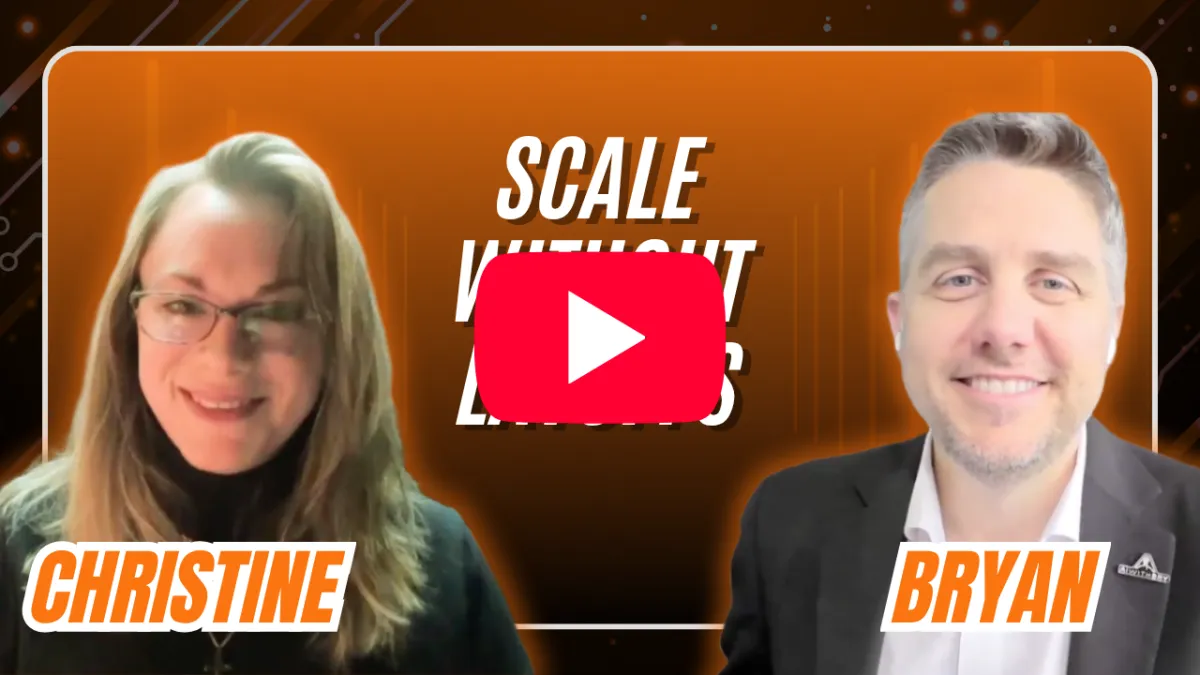
In this episode of AI with Bry, I sit down with Christine Santacroce, a people-first leader, founder of Virago Search, and co-creator of SkillzForge, who is on a mission to flip that script.
Instead of treating AI as a shortcut to layoffs, Christine shows how it can unlock creativity, rebuild the middle class, and make work actually work for people again. This isn’t theoretical. She’s using AI every day in recruiting, skilled labor matching, and business operations and she’s doing it without sacrificing humanity.
From Terminator 2 Fear to Trusted Tool
Christine admits she started where a lot of us did, somewhere between curiosity and “oh no, this is how the movie starts.” But as she leaned in, one lesson became crystal clear:
AI is human-driven. What you put in is what you get out just multiplied.
Instead of seeing AI as an enemy of jobs, she reframed it as:
A way to remove manual, soul-draining busywork
A way to help small businesses compete with bigger players
A way to make room for meaningful, human work, conversations, strategy, creativity, relationships
The fear didn’t disappear, it got replaced with responsibility.
The Quiet Crisis: We Optimized the Soul Out of Work
Over 20+ years in the market, Christine has watched something subtle but dangerous happen:
We’ve optimized the same systems over and over
Speed and profit became the default goals
Innovation and creativity quietly shrank
People became less and less happy in their careers
For many employees, work now looks like this:
Spend Saturday recovering from the week
Spend Sunday dreading Monday
Spend years wondering if this is just… it
Christine believes AI can disrupt that, but not by automating people out of the picture. Instead, it can unwind broken systems in:
Healthcare
Education
Supply chains and food systems
Talent and recruiting
AI becomes the tool that lets us ask: “If we were designing this from scratch, human-first—how would we build it?”
How a Small Recruiting Firm Uses AI to Punch Above Its Weight
Christine runs a small, tech- and AI-enabled recruiting firm. A few years ago, competing with large firms was nearly impossible:
No massive marketing budget
No huge sourcing teams
No in-house creative departments
Today, she’s using AI to change that equation:
1. Marketing & Brand Presence
Using tools like ChatGPT to self-learn marketing fundamentals. Building professional-looking campaigns, visuals, and copies. Generating site content, social posts, and outreach that would’ve required a full marketing team.
2. Recruiting Workflows
Recruiting has always been manual-heavy. It requires, endless sourcing and web scraping and repetitive candidate screening. Now, Christine and her team use model context protocols (MCP) and AI workflows to automate 50–60% of manual tasks. It frees up time to focus on what actually matters like having deep conversations with clients, understanding what’s broken in their hiring, and matching people to the right role not just any role.
3. SkillzForge: Rebuilding the Middle Class with Better Matching
Through SkillzForge, Christine is working on one of the hardest problems in the labor market. The gap between talent + skill and real opportunity. There is, no consistent bridge for skilled workers or no simple, trusted system to match the right person to the right job, fast. AI becomes the bridge that maps skills to roles more intelligently, helps people land in jobs where they can thrive, not just survive, and puts more middle-class Americans back on a realistic path to stability (yes, including “I might actually be able to buy a house someday”).
The Real Question Leaders Should Be Asking
Most leaders still open the AI conversation with:
“How much of my staff can I cut?”
Christine flips that completely:
“How much can you increase profitability with the same staff?”
AI should:
Amplify your people, not erase them
Turn overwhelmed teams into high-leverage teams
Help you get through the to-do list instead of cutting the people holding it
Think about what’s currently stuck in backlog at your company:
Social media and content that never gets posted
Marketing campaigns that never launch
Hiring pipelines that always feel behind
Books that never close on time
Prospect research that sales “never has time” to do
AI gives you the chance to:
Automate the drudge work
Let your teams breathe, think, and create
Replace constant burnout with room for innovation
Governance, Ethics, and Saying “No” to Shady Use Cases
Christine is clear: just because AI can do something doesn’t mean you should let it. Her companies, Virago Search and Skillsforge, use guiding principles to decide what’s in bounds:
Would this help people thrive at work—or trap them?
Does this respect candidates and clients, or manipulate them?
Does this align with our goal: match the right people to the right opportunities?
Some ideas could drive revenue but feel off, like using sentiment analysis on live conversations to subtly manipulate prospects. Her answer?
“Somebody else might build that. We’re not going to.”
Ethical AI isn’t a slogan for Christine; it’s an operating constraint.
Leadership in the Age of AI: Train People, Don’t Terrify Them
Christine sees the same pattern over and over with companies adopting AI:
They assume employees fear change
They quietly frame AI as a path to layoffs
Employees react with anxiety and resistance (of course they do)
Instead, Christine advises leaders to:
Acknowledge reality: Your employees are probably already using AI—often in risky ways you can’t see.
Shift the narrative:
From: “We’re adopting AI, some of you may go.”
To: “We’re adopting AI, and we’re going to train you to become more valuable with it.”
Invest in training, not just tools and teach people:
How to prompt safely
How to use AI in their specific role
Where the guardrails are (privacy, security, compliance)
Invite ideas from the front lines and real innovation doesn’t always come from the boardroom. It often comes from:
The claims adjuster who knows a broken workflow is costing 25% efficiency
The recruiter buried in tools that don’t talk to each other
The coordinator who knows exactly where the bottlenecks are
When people feel safe, trained, and invited, they stop bracing for layoffs and start designing the future with you.
From Layoffs to Long-Term Value
For decades, the default strategy has been:
Miss a number
Announce layoffs
Please the market
Rehire later
Repeat
With AI, we finally have an alternative:
Fix broken workflows
Automate time-consuming nonsense
Keep your best people
Give them tools to maximize their strengths
Use AI to build, not just trim
Christine’s challenge to leaders is simple and profound:
What if you got better at what you do—without sacrificing your people to do it?
Listen to the Full Conversation
If this resonated with you, you’ll want to hear the full episode:
🎙 Podcast Episode: Beyond Headcount Cuts: Scale with AI—and Keep Your People
📺 Watch / Listen: AI with Bry — visit ai.bry.net
Connect with Christine Santacroce
Want to see how AI-enabled recruiting and people-first leadership actually look in the real world?
💼 Virago Search – People-first recruiting, powered by AI
🌐 Website: Virago Search (search for “Virago Search” online)
📧 Email: [email protected]
🚀 Skillsforge – AI-powered matching for skilled labor and middle-class careers
And of course, you can find Christine on LinkedIn by searching for “Christine Santacroce Virago Search”.
Follow AI with Bry
For more conversations at the intersection of AI, leadership, and human potential:
Facebook: https://www.facebook.com/profile.php?id=61575757332333
Instagram: https://www.instagram.com/aiwithbry
TikTok: https://www.tiktok.com/@aiwithbry.com
YouTube: https://www.youtube.com/@aiwithbry
X (Twitter): https://x.com/aiwithbry
LinkedIn: https://www.linkedin.com/in/phingers
Know a colleague who needs to hear this? Share the AI with Bry podcast and join the movement of leaders transforming their businesses with AI — one actionable step at a time.
Episode's Transcript
Please understand that a transcription service provided the transcript below. It undoubtedly contains errors that invariably take place in voice transcriptions.
[00:00.000] Sarah Cornett:
Up to 80 to 90% of AI projects fail to deliver. So there's really a huge gap still.
[00:23.342] Bryan Dennstedt:
It feels like it's almost going back to the basics—like, get out the crayons and color, and learn how to draw again. There are all these new opportunities now in this AI world that we're in.
[00:23.342] Bryan Dennstedt:
Hey everybody, welcome back to AI with Bry, the show where we dive deep into how to learn, leverage, and lead with AI. I'm your host, Bryan Dennstedt — technologist, strategist, and someone deeply curious about how AI is reshaping our lives and work.
Today, I’m thrilled to welcome Sarah Cornett to the show. Sarah, welcome.
[00:39.512] Sarah Cornett:
Thank you, Bryan — so excited to be here.
[00:41.271] Bryan Dennstedt:
Sarah is the founder and CEO of Global AI Advisors, helping organizations turn AI strategy into real business value. She brings a unique blend of quantitative finance, enterprise strategy, and deep knowledge in governance and AI adoption.
We’ve gotten to talk a few times about how to make AI practical, impactful, and people-centered. I'm really looking forward to today’s conversation because you're bringing both technical depth and business perspective — which is something so many leaders are trying to balance right now.
[01:09.112] Sarah Cornett:
Absolutely. Yes. We are definitely living in a new AI era. There are so many ways we can talk about the future of AI and what this means for organizations.
[01:23.580] Bryan Dennstedt:
Let’s dive into the Learn segment. What’s something you’ve learned recently that really stood out?
[01:29.442] Sarah Cornett:
From working with organizations on AI transformation, what really stands out is that we still have a long way to go. I recently learned that 80–90% of AI projects fail to deliver expected value. That was an alarming statistic.
[02:39.138] Sarah Cornett (continued):
Some of it is technical — like data availability or infrastructure. But one of the biggest reasons for failure is leadership.
Leaders are still learning how to adopt AI, how to align it with strategy, and how to guide teams through change. There’s a major gap in education and leadership around AI.
[03:29.512] Bryan Dennstedt:
It’s so true. It feels like we have to go back to the basics — like, touch it, play with it, break it, and see what it can do. You touched on the data gap, but also on workflow. There are so many ways you can apply AI across roles. How do you help leaders learn and experiment?
[04:57.280] Sarah Cornett:
Great question. First, I always advise starting with an AI strategy. What are your goals? Where is your industry going? What value could AI bring to your customers?
Then you prioritize use cases — not just by business value, but also feasibility. You don’t want to start with something that could take 10 years to implement. Find the high-impact, low-hanging fruit — that’s where you build momentum.
[07:10.868] Bryan Dennstedt:
What’s a tool you’ve recently used that everyone should check out?
[07:15.412] Sarah Cornett:
I use ChatGPT, Claude, and Perplexity almost daily. But lately, I’ve been playing with Perplexity’s Comet feature — it’s like their version of web browsing, and it’s really powerful. Highly recommend trying it.
[08:02.300] Bryan Dennstedt:
You’ve already started touching on this — but let’s unpack leverage. I believe AI is going to be like electricity — every business will use it. Where do companies start?
[09:12.428] Sarah Cornett:
It always starts with your strategy — that becomes your guide. Then, once you’ve identified the right use cases, you need to layer in education and change management.
People need to understand their roles with AI. How does leadership change? How do teams evolve?
I've worked with analytics teams, marketing teams — and the most powerful training is always customized to the tools, tasks, and challenges that specific team is facing.
[11:28.098] Bryan Dennstedt:
I love that. And I think as AI becomes more embedded in orgs, planning becomes more important. We’re used to agile, but maybe more detailed planning enables better AI results. Are you seeing that?
[12:55.320] Sarah Cornett:
Totally. It starts with leadership — understanding team structure, AI vs. human responsibility, and defining the workflows.
I've spoken at conferences on the future of work, and we see three big buckets:
AI replaces roles — like memo writers in the pre-Internet era.
AI augments roles — freeing humans to focus on high-value work.
New roles emerge — AI strategists, ethicists, prompt engineers.
[16:13.228] Bryan Dennstedt:
Yes! And I say this almost every episode: we’re entering a new Renaissance era — creativity will explode. But we need structure — especially governance. Without it, people are spending money on ChatGPT with no oversight.
[17:22.301] Bryan Dennstedt:
Let's close with leadership. How are you helping teams grow in this space?
[17:32.412] Sarah Cornett:
I’m doing a lot around AI leadership development — especially educating leaders on governance, investment, and human-centered adoption.
Governance is huge. And human-centered leadership is critical. We can’t just replace people — we need to lift them upand help them adapt. That’s the kind of leadership this moment calls for.
[20:46.122] Bryan Dennstedt:
Yes — and we need explainability too. People have to understand how the AI came to its decision. That’s leadership’s responsibility.
[21:14.372] Sarah Cornett:
Exactly. I’ve worked with banks and healthcare orgs to stand up governance programs. Some industries — like healthcare — start with governance first, due to regulation.
If you’re new to AI, start with your data governance. Then, establish a governance board, educate them, and build a workflow for approval before AI is pushed to production.
[23:04.992] Sarah Cornett (continued):
Make sure you’re aware of regulations like EU AI Act or state-specific US policies. Your governance program should align your legal, compliance, and tech teams. That’s how you lead with responsibility.
[24:31.112] Bryan Dennstedt:
Love that. And it all ripples out — governance → data → security → workflows → business outcomes. That’s what leadership with AI looks like.
[25:00.821] Bryan Dennstedt:
Tell us how people can connect with you and Global AI Advisors.
[25:10.100] Sarah Cornett:
You can reach me on LinkedIn. At Global AI Advisors, we help with strategy, governance, implementation, and leadership development. We also offer executive education and speak at conferences and internal events.
[26:10.112] Bryan Dennstedt:
Awesome. Please reach out to Sarah or me if you need help with your AI journey. Sarah, thank you so much for joining us — this was a powerful episode.
[26:33.528] Bryan Dennstedt:
This episode of AI with Bry was hosted and produced by me, Bryan Dennstedt. Special thanks to Nancy Velazquez and Kelly Lopez. Video by Leo Moralina. Sound: AI-generated.
🎧 Find us on all platforms at ai.bry.net
📱 Follow @aiwithbry: