Blog
No, You Did Not Waste a Gallon of Water Generating That Image
One AI image uses less water than a single drop. The viral "a bottle of water per prompt" number is doing something the math does not support. I care about water. That is exactly why I want the panic pointed at the right target.
I am vegan. I read the water footprint of my food before I changed how I eat. So when a headline tells me the AI image I just generated cost a bottle of water, I do not roll my eyes. I go check the number.
The number does not hold up.
What one image actually costs
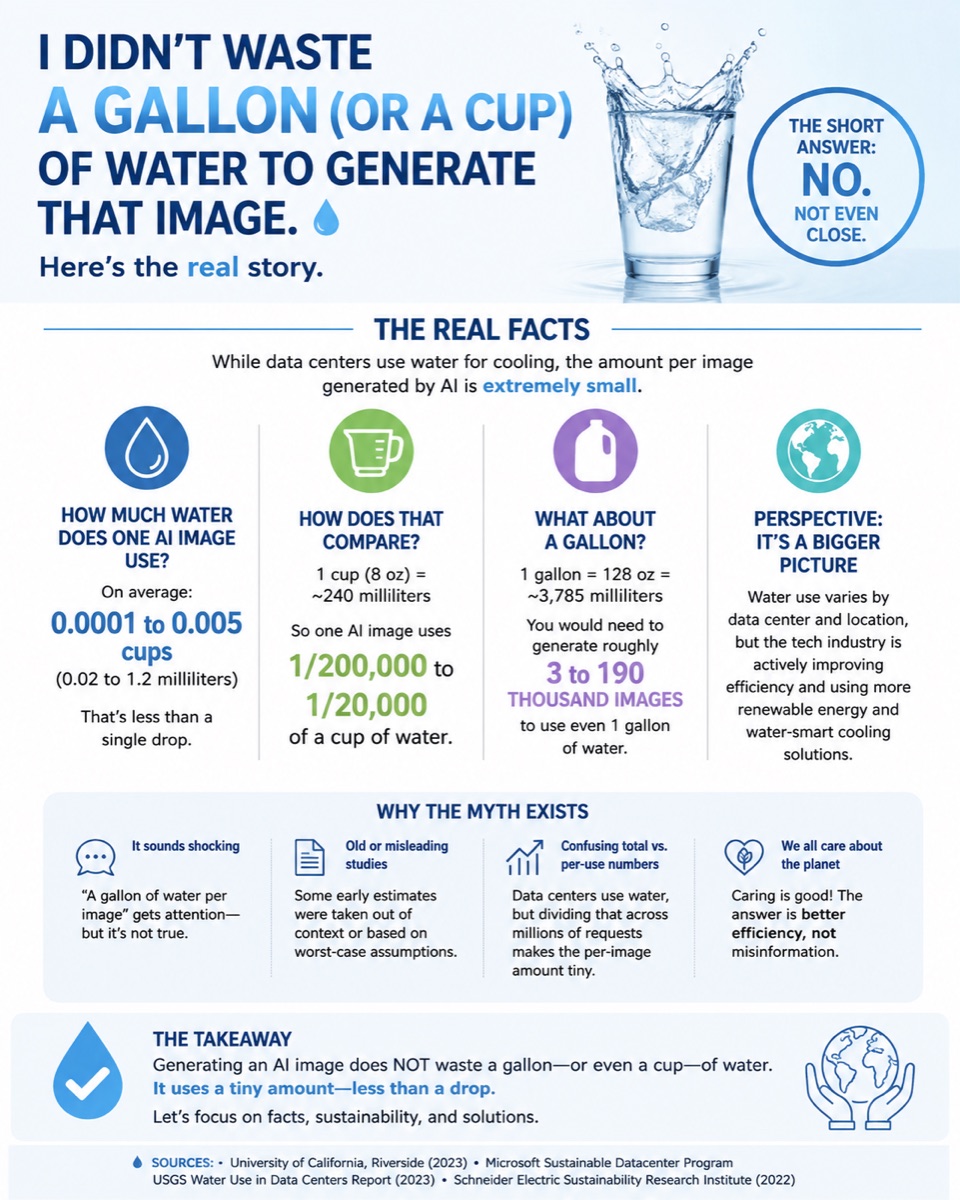
The water used to generate a single AI image lands somewhere between 0.0001 and 0.005 cups. That is 0.02 to 1.2 milliliters. Less than a single drop off your fingertip.
Put a cup of water next to it. One cup is about 240 milliliters. One AI image is between 1/200,000 and 1/20,000 of that cup.
You would have to generate somewhere between 3,000 and 190,000 images to use a single gallon of water. Not per day. Total.
That is the real per-image number, sourced from the University of California, Riverside data center work, the USGS water use reporting, and the sustainability disclosures from the companies actually running the servers. It is not a rounding error. It is smaller than a rounding error.
Where the scary number came from
The "half a liter per prompt" figure that went viral is not made up. It comes from real research on data center cooling and power. But two things happened to it on the way to your feed.
First, people took a worst-case estimate, from a specific location, in a specific season, on a specific older model, and treated it as the number for everything. Water use for a data center in Arizona in August is not water use in Ireland in February. The averages are far lower than the headline.
Second, and this is the big one, people took a total and quietly turned it into a per-use. A data center uses water. Divide that across the hundreds of millions of requests it serves and the per-request slice gets tiny. Multiply the tiny slice back up and wave the big total around, and you can scare anyone. That is not analysis. That is a magic trick.
Why I still care about data center water
Here is where I break from the people who want to end the conversation at "the number is small, relax."
The per-image number is small. The industry total is not nothing. Data centers are real buildings pulling real water and real power out of real grids, and some of them sit in places that cannot spare either. That is a genuine infrastructure question, and it deserves genuine engineers working on it.
The good news is that they are. Cooling is getting more efficient every year. More facilities are moving to closed-loop systems, air cooling, and reclaimed water. More of the power behind them is renewable. The trend line on water-per-computation is going down, fast, because the people paying the water bill want it down too.
So the honest position is not "AI uses no water." It is "AI uses a tiny amount per use, the aggregate is a solvable engineering problem, and it is already being solved." Both of those are true at once.
The math I actually want you to do
If you care about water, and I do, then spend your worry where the water is.
- The per-image guilt is misplaced. You will not save a meaningful drop by not generating an image. You will save more by fixing one running toilet in your house for one day.
- The aggregate is an engineering story, not a moral one. The lever is cooling design and energy mix, and those are pulled by the companies and the grid, not by you skipping a prompt.
- Follow the biggest water user, not the loudest headline. In most people's lives, the largest water footprint by a wide margin is on their plate, not on their screen. That is the post I am writing next.
The takeaway
Generating an AI image does not waste a gallon of water. It does not waste a cup. It uses less than a drop.
Caring about the planet is good. I do it every day, at the grocery store and everywhere else. But caring only works when the numbers are real. Point the concern at cooling systems and energy grids, where a working engineer can actually move something. Do not point it at the drop.